

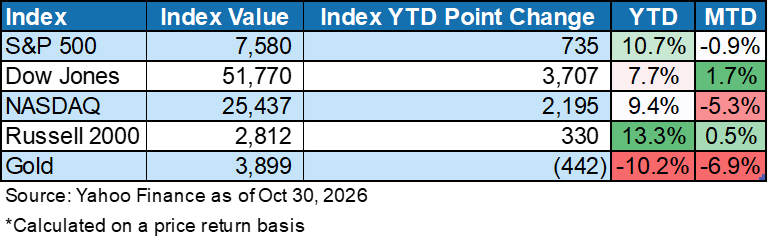
Highlights:
French government bonds (OATs) sold off amidst concerns surrounding debt levels and economic growth. However, OATs represent just ~3% of global bond indexes and pose minimal direct risk exposure to most investors. [1]
Inflation grew at a 3.7% annual rate in September with the Consumer Price Index (CPI) showing a 20.4% increase in energy prices. [2]
The Federal Reserve held interest rates steady in a range of 3.75%-4.00% during their meeting last week. [3] Markets are currently pricing a 73% likelihood the Fed hikes a quarter of a percent during the December meeting. [4]
Through the end of October, 60% of companies in the S&P 500 have reported earnings. Thus far, earnings have been 1.9% above estimates, which is lower than the 5-year and 10-year average beat rates of 7.5% and 8.0%, respectively. [5]
Big tech firms contributed to the earning weakness, while their massive contributions to the AI buildout are having investors question the ROI.
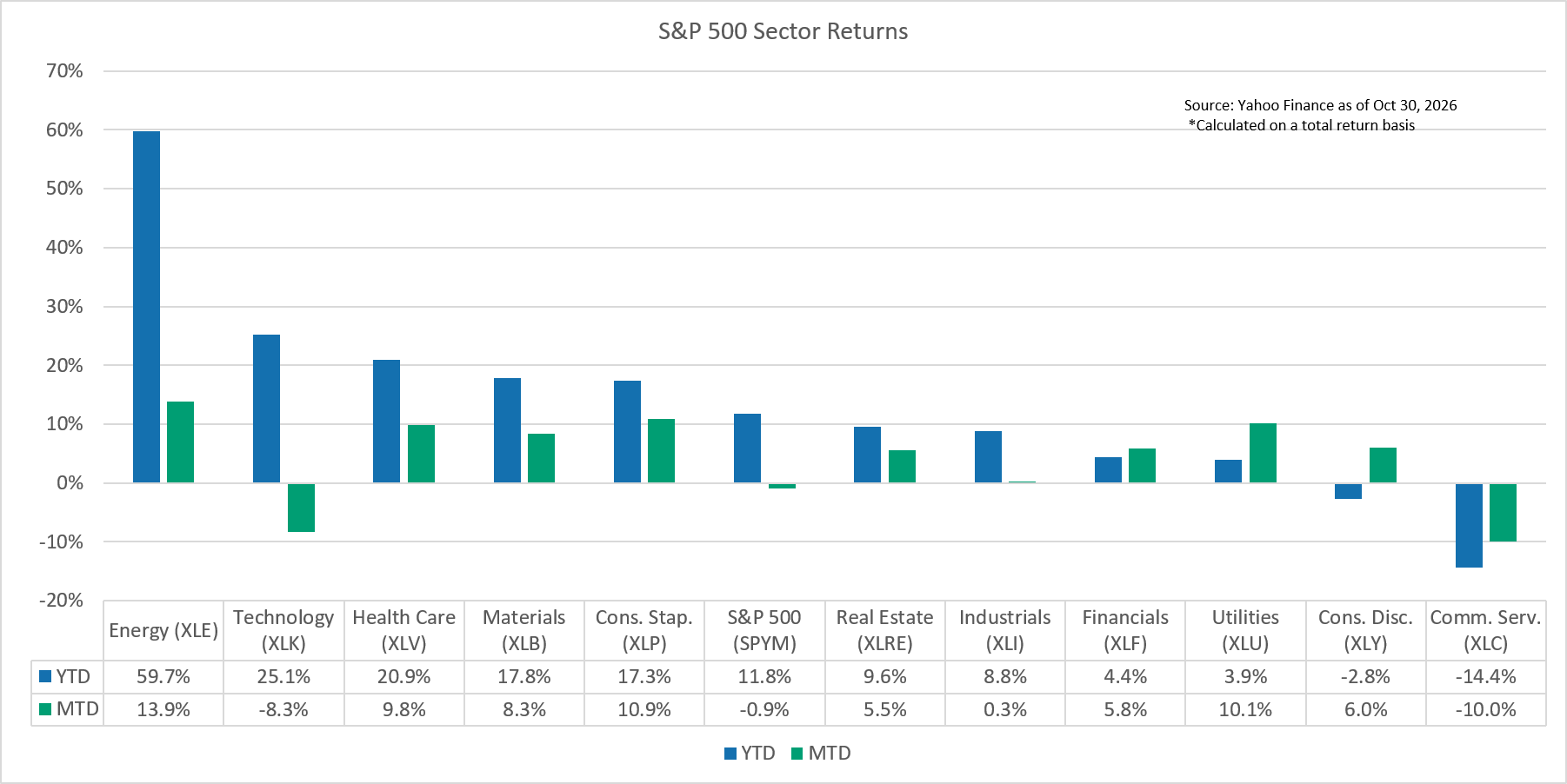
In a reversal to September’s trend, which saw all sectors ex-technology posting a negative return, last month only saw the technology and communication services sectors fall in price. Despite positive gains across the investing landscape, the S&P 500 lost money in October due to tech’s weight in the index. Several big tech firms sold off following lackluster earnings reports, which had investors scrutinizing the scale of their investments in AI related infrastructure.
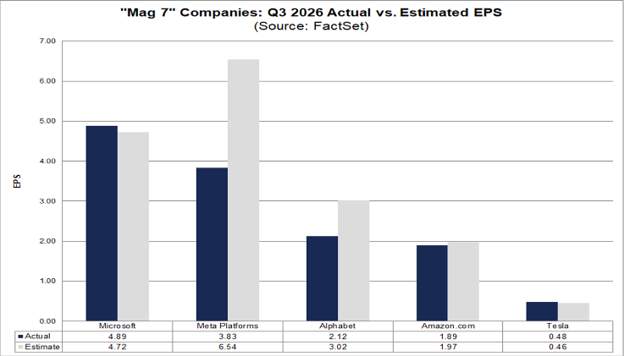
While each company disclosed unique challenges and opportunities, a unifying risk is the return on investment the AI buildout presents. Currently, Hyperscalers (defined below) are projected to spend $967 billion in 2026 and $1.4 trillion in 2027, which will mostly go towards datacenters and semiconductors that process large language model queries. However, it’s unclear whether growth in cloud revenues and productivity across the economy will offset the extraordinary amount of capital being committed.
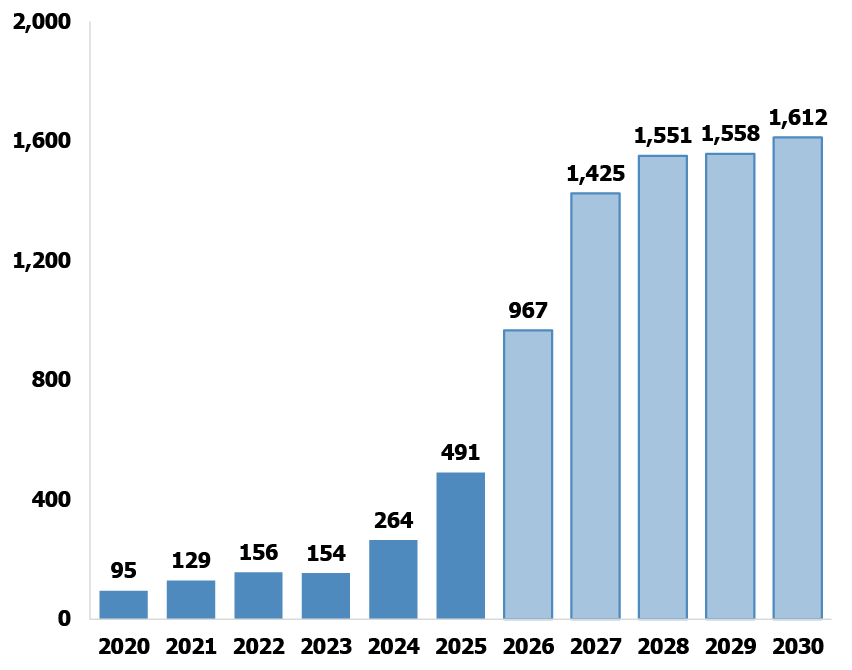
Annual Cloud Capex ($B)
Note: Capex dataset accounts for several cloud/neocloud operators including: Amazon, Google, Microsoft, Meta, Oracle, CoreWeave, Nebius, IREN, and SpaceX; All forward estimates are based on median consensus estimates
Source: J.P. Morgan Cloud Capex Dataset, Bloomberg Finance L.P.
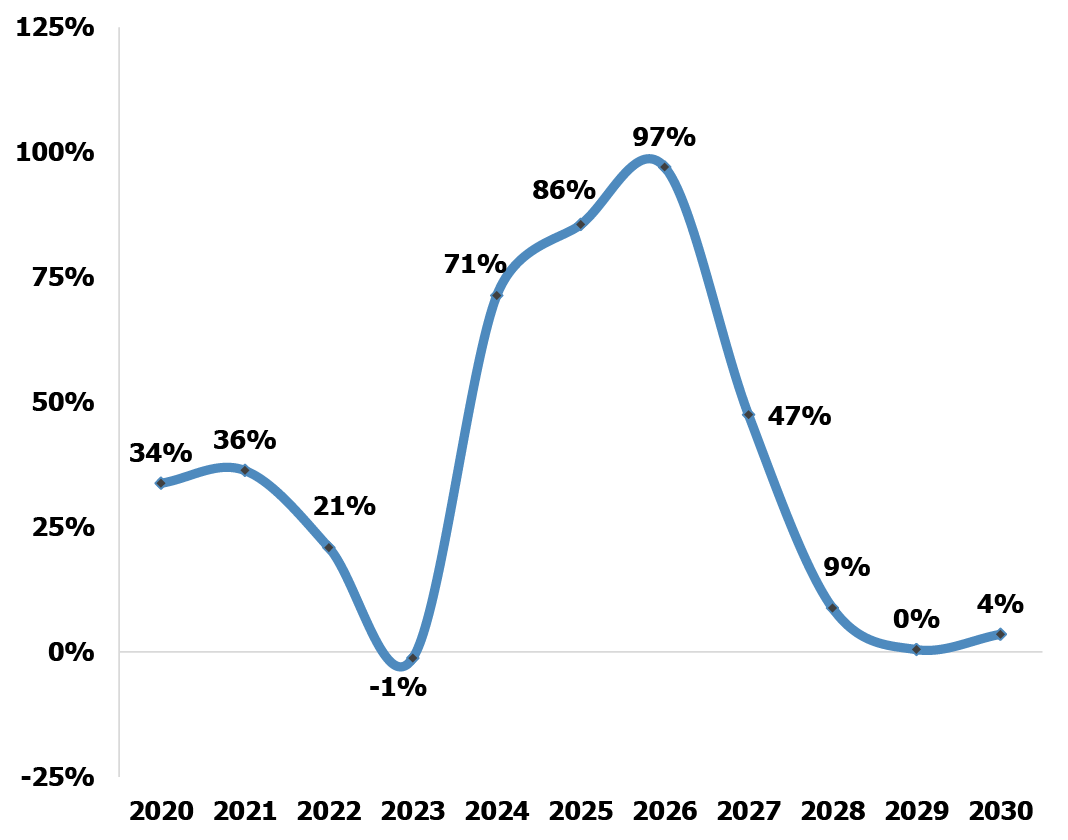
Y/Y Change in Cloud Capex (%)
Note: Capex dataset accounts for several cloud/neocloud operators including: Amazon, Google, Microsoft, Meta, Oracle, CoreWeave, Nebius, IREN, and SpaceX; All forward estimates are based on median consensus estimates
Source: J.P. Morgan Cloud Capex Dataset, Bloomberg Finance L.P.
A factor suggesting demand for cloud related compute is robust, is the exponential growth in token volumes and spending. Over the past year, volume has spiked 33x while spend followed suit at 20x. This explosion in demand is a key reason Hyperscalers are investing trillions of dollars to build datacenters across the country.
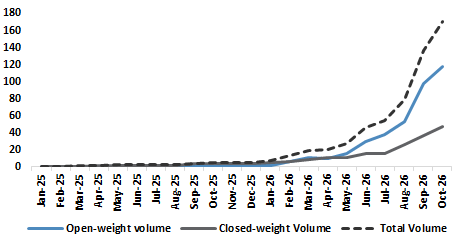
Token Volume in Trillions
Source: OpenRouter, J.P. Morgan Estimates
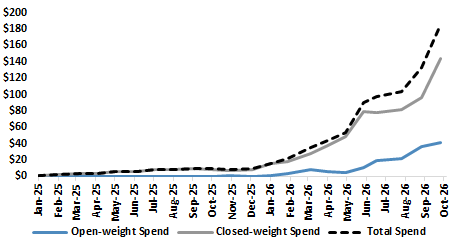
Weekly Token Spend in $Millions
Source: OpenRouter, J.P. Morgan Estimates
Despite increasing demand, we have yet to see meaningful financial gains from the nascent technology equitably spread across the economy. For example, while profit margins of the “Magnificent 7,” a proxy for big tech, have soared the same cannot be said for the rest of the companies in the S&P 500.
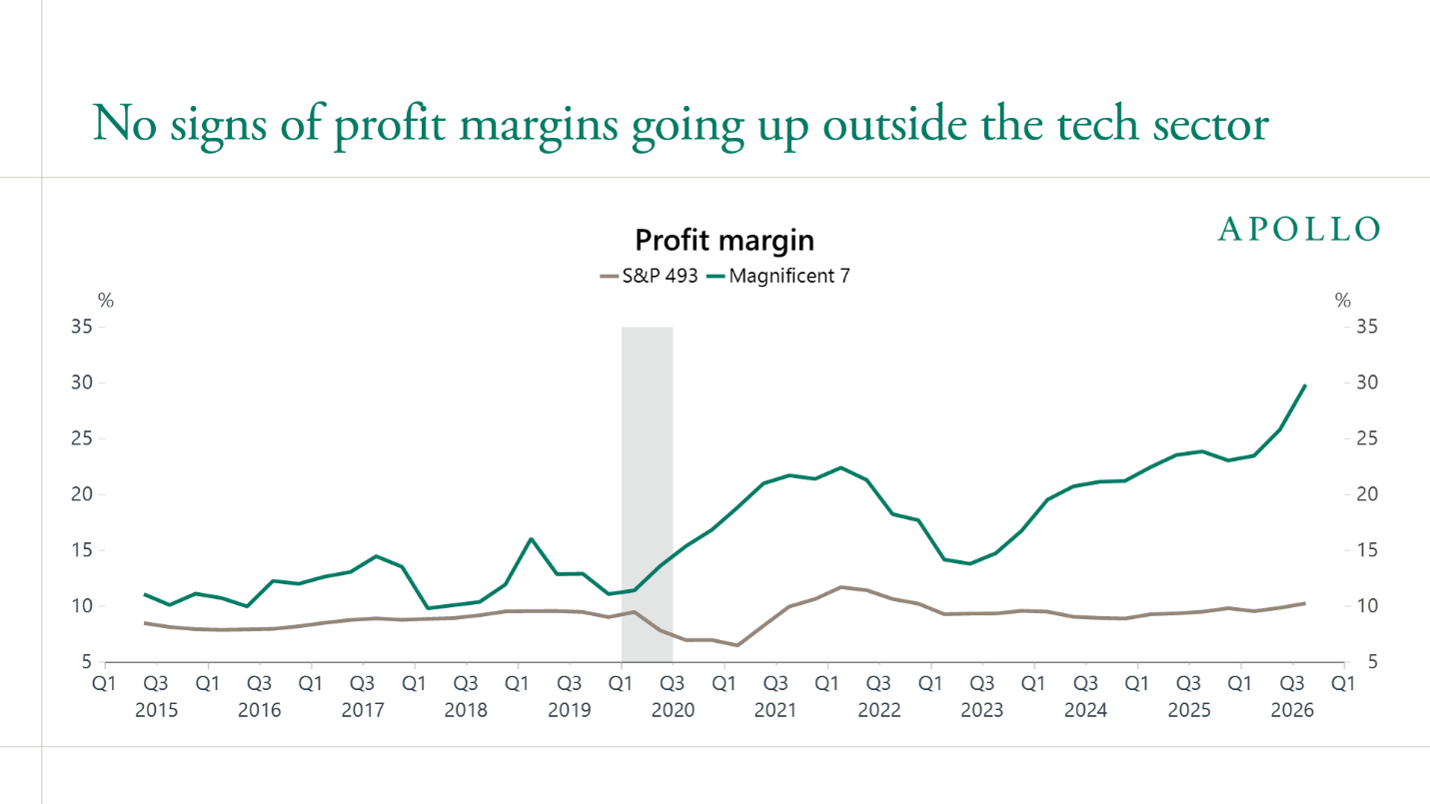
Sources: Bloomberg, Macrobond, Apollo Chief Economist
Although the financial benefits have not yet accrued broadly across the economy, you may recall that five years ago, few investors viewed AI as a viable business model. Fast forward to today and companies like Anthropic, founded in 2021, are generating billions in annual revenues and planning to go public [9]. Therefore, humility is warranted when making predictions about the next five years as today’s investment landscape is rapidly evolving. For investors, the uncertainty surrounding AI’s payoff requires building risk-aware portfolios that are flexible enough to participate in continued gains while remaining resilient during periods of adversity.
Sources:
iShares Core International Aggregate Bond ETF (IAGG), BlackRock; Vanguard Total World Bond ETF (BNDW), Vanguard. Author’s calculations using fund holdings data. iShares IAGG | Vanguard BNDW
U.S. Bureau of Labor Statistics. Consumer Price Index, September 2026, October 14, 2026. BLS CPI data
Board of Governors of the Federal Reserve System. Federal Reserve Issues FOMC Statement, October 28, 2026. Federal Reserve
CME Group. CME FedWatch Tool. Accessed October 30, 2026. CME FedWatch
FactSet Research Systems Inc. Earnings Insight, October 30, 2026. FactSet Earnings Insight
J.P. Morgan Research. 3Q26 Sector Preview: Constructive Setup Intact as Supply Constraints, AI Momentum, and Cyclical Recovery Support Further Revisions / Continued Equity Outperformance, October 12, 2026.
J.P. Morgan Research. Data Center Watch: Token Spend Growth Accelerates in October Amid Mixed GPU Rental and Memory Pricing, October 26, 2026.
Apollo Chief Economist. No Signs of AI Payoff Outside the Tech Sector, The Daily Spark, October 24, 2026. Data sources include Bloomberg and Macrobond for the profit-margin chart. Apollo
Anthropic PBC. Registration Statement on Form S-1, U.S. Securities and Exchange Commission, 2026. SEC filing
Important Disclosures:
This commentary is provided by Sella Wealth LLC for informational and educational purposes only and should not be construed as personalized investment, tax, legal, or accounting advice. The views expressed are those of Sella Wealth as of the date of publication and are subject to change without notice.
Past performance is not indicative of future results. All investments involve risk, including the possible loss of principal. References to specific securities, companies, sectors, asset classes, indexes, or investment strategies are for illustrative purposes only and do not constitute a recommendation to buy, sell, or hold any security. Index performance is presented for informational purposes only, does not reflect fees or expenses, and indexes cannot be invested in directly.
Market forecasts, estimates, projections, and other forward-looking statements are based on current expectations and assumptions and are inherently uncertain. Actual results may differ materially from those anticipated, and there is no guarantee that any forecast, projection, estimate, or opinion discussed herein will be realized.
Information, data, charts, and third-party research have been obtained from sources believed to be reliable, but Sella Wealth does not independently guarantee their accuracy, completeness, or timeliness. Third-party names, trademarks, data, research, and other materials remain the property of their respective owners. Reference to or use of third-party information does not imply affiliation with or endorsement by those parties.
Asset allocation and diversification do not guarantee a profit or protect against loss. Investors should consider their individual investment objectives, financial circumstances, time horizon, and tolerance and capacity for risk before making investment decisions.
Sella Wealth LLC is a registered investment adviser. Registration as an investment adviser does not imply a certain level of skill or training. Advisory services are offered only where Sella Wealth and its representatives are properly registered or exempt from registration. Nothing contained herein constitutes an offer to sell or a solicitation of an offer to buy any security or investment advisory service.
